|
| |
 |
|
David Weiss
Professor
Tel: +972 8 9489436
Fax: +972 8 9489960
E-mail: weiss@agri.huji.ac.il
Research Interests
Gibberellin signal transduction

Studies of gibberellin-signal transduction, using genetic approaches,
led to the identification of positive and negative signaling components.
The current model suggests a nuclear gibberellin signaling:
gibberellin binds to its receptor GID1 which in turn interacts with the
DELLA repressors in the nucleus. This leads to DELLA’s polyubiquitination
and degradation and consequently, to the stimulation of gibberellin responses.
Other studies have revealed additional signaling components,
including the nucleocytoplasmic protein SPY.
The mechanism by which SPY regulates gibberellin responses is not yet clear,
but the model suggests that it promotes the activity of DELLA in the nucleus
to suppress gibberellin responses. We found that SPY acts in the cytosol to
suppress gibberellin signaling. We are studying if a cytosolic gibberellin
signaling pathway exists in Arabidopsis and tomato.
O-GlcNAc protein modifications in the regulation of hormone
signaling networks in plants
Addition of O-linked N-acetylglucosamine (O-GlcNAc) to Ser and
Thr residues by O-GlcNAc transferases (OGTs) regulates the post-translational
fate and function of target proteins. O-GlcNAc modifications of animal
cytosolic and nuclear proteins affect their localization, phosphorylation,
interaction with other proteins and/or stability. The Arabidopsis genome
encodes two OGTs, SPY and SEC. SPY suppresses gibberellin signaling,
promotes cytokinin responses and has a role in the negative interaction
between the two hormones. Our goal is to elucidate the mechanism by which
SPY regulates hormone responses and plant development.
The role of GAST-like proteins in gibberellin responses and plant development

While gibberellin signal transduction has been elucidated, very little is
known about the later steps linking first transcriptional activation to
physiological responses. Among the few identified gibberellin-regulated
genes are the plant-specific GAST1-like genes, which encode small proteins
with a conserved cysteine-rich domain. We found that proteins from this family
promote or suppress specific gibberellin responses in Arabidopsis and
petunia and demonstrated that they are involved in redox reactions via
their cysteine-rich domain. Our hypothesis suggests that gibberellin
induces or suppresses the transcription of various GAST1-like genes, and
the encoded proteins are used to translate the gibberellin signal into
physiological and developmental responses by regulating the redox status,
and thus the activity of specific components.
Gibberellin and osmotic stress
Drought and salinity (osmotic stress) have a major impact on agriculture
and are responsible for major losses in crop productivity.
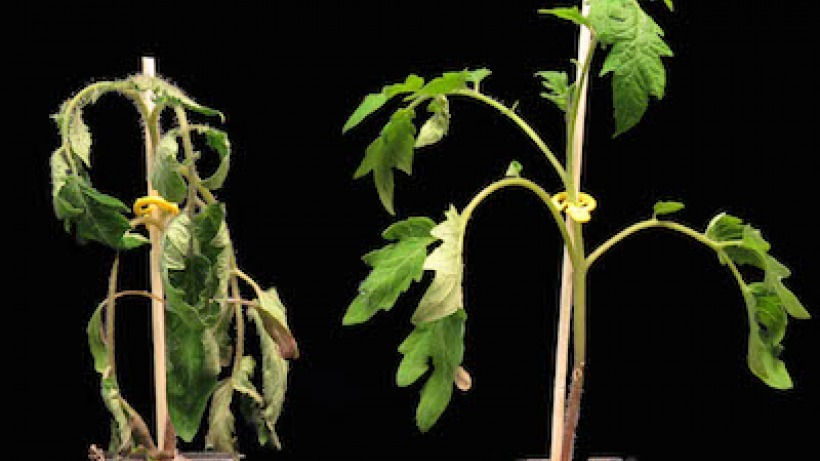
We found that reducing the levels of active gibberellin in tomato,
increased the plants' resistance to high salinity and drought.
Our goal is to reveal the mechanism of interaction between GA and
osmotic stress.
Introduction of new ornamentals
We are conducting applied studies aimed at developing new ornamentals.
This includes developing propagation methods for new crops, studying
growth and flowering physiology and developing practical means for their
control, studying post-harvest physiology and developing practical methods
for post-harvest handling and storage. Several new crops, such as
Echinops, Globularia, and Eucomis,
have been developed by us in the last few years.
Teaching activities
- Undergraduate courses
- Plant Physiology (71015)
- Physiology of flowering (71449)
- Biology and production of ornamentals (71416)
- Basic techniques in molecular biology (71204)
- Graduate courses
- Signal transduction in plants (71101)
Current Members of the Group
- Sivan Livne, Ph.D. Student
- Lior Rubinovich, Ph.D. Student
- Evyatar Steiner, Ph.D. Student
- Ido Nir, M.Sc. Student
- Ofra Ziv, Technician
Selected Publications
Fleishon S., Shani E., Ori N. and Weiss D. (2011)
Negative reciprocal interactions between gibberellin and cytokinin in tomato.
New Phytol. (In press)
Rubinovich L. and Weiss D. (2010)
The Arabidopsis cysteine-rich protein GASA4 promotes GA responses and
exhibits redox activity in bacteria and in planta. Plant J. 64: 1018-1027
Shani E., Melnik H., Shleizer-Burko S., Burko Y., Weiss D. and Ori N. (2010)
Cytokinin regulates compound leaf development. The Plant Cell 22:3206-3217
Bar-Akiva A., Ovadia R., Rogachev I., Bar-Or C., Bar E., Freiman Z.,
Nissim-Levi A., Gollop N., Lewinsohn E., Aharoni A., Weiss D., Koltai H. and
Oren-Shamir M. (2010) Metabolic networking in Brunfelsia calycina petals
after flower opening. J. Exp. Bot. 61: 1393 – 1403
Farhi M., Lavie O., Masci T., Hendel-Rahmanim K., Weiss D., Abeliovich H.
and Vainstein A. (2010) Identification of rose phenylacetaldehyde synthase
by functional complementation in yeast. Plant Mol. Biol. 72: 235-245
Maymon I., Greenboim-Wainberg Y., Sagiv S., Kieber J.J., Moshelion M.,
Olszewski N. and Weiss D. (2009) Cytosolic activity of SPINDLY implies the
existence of a DELLA-independent gibberellin-response pathway.
Plant J. 58: 979-988
Hendel-Rahmanim K., Masci T., Vainstein A. and Weiss D. (2007)
Diurnal regulation of scent emission in rose flowers. Planta, 226: 1491-1499.
Weiss D. and Ori N. (2007) Mechanisms of cross-talk between gibberellin and
other hormones. Plant Physiol. 144: 1240-1246
Varbanova M., Yamaguchi S., Yang Y., McKelvey K., Hanada A., Borochov R.,
Yu F., Jikumaru Y., Ross J., Cortes D., Ma C-J., Noel J., Mander L.,
Shulaev V., Kamiya Y., Rodermel S., Weiss D. and Pichersky E. (2007)
Methylation of gibberellins by Arabidopsis GAMT1 and GAMT2.
The Plant Cell 19: 32-45.
Weiss D. and Ori N. (2007) Mechanisms of cross-talk between gibberellin and
other hormones. Plant Physiol. 144: 1240-1246.
Hendel-Rahmanim K., Masci T., Vainstein A. and Weiss D. (2007)
Diurnal regulation of scent emission in rose flowers. Planta, 226: 1491-1499.
Wigoda N., Ben-Nissan G., Granot D., Schwartz A. and Weiss D. (2006) The
gibberellin-induced, cysteine-rich protein GIP2 from Petunia hybrida exhibits in-planta
antioxidant activity. Plant J. 48: 796-805.
Kaminaga Y., Schnepp J., Peel G., Kish C.M., BenNissan G., Weiss D., Orlova I., Lavie O.,
Rhodes D., Wood K., Porterfield M., Cooper A.J.L., Schloss J.V., Pichersky E., Vainstein A.,
and Dudareva N. (2006) Plant phenylacetaldehyde synthase is a bifunctional homotetrameric
enzyme that catalyzes phenylalanine decarboxylation and oxidation. J. Biol. Chem. 281:
23357-23366.
Farhi M., Dudareva N., Masci T., Weiss D., Vainstein A. and Abeliovich H. (2006)
Synthesis
of the food flavoring methyl benzoate by genetically engineered Saccharomyces cerevisiae. J.
Biotech. 122: 307-315.
Guterman I., Masci T., Chen X., Negre F., Pichersky E., Dudareva N., Weiss D. and
Vainstein A. (2006) Generation of phenylpropanoid pathway-derived volatiles in transgenic
plants: rose alcohol acetyltransferase produces phenylethyl acetate and benzyl acetate in
petunia flowers. Plant Mol. Biol. 60: 555-563.
Dafny-Yelin M., Guterman E., Menda N., Ovadis M., Shalit M., Pichersky E., Zamir D.,
Lewinsohn E., Adam Z., Weiss D. and Vainstein A. (2005) Flower proteome-changes in protein
spectrum during the advanced stages of rose petal development . Planta 222: 3746.
Vaknin H., BarAkiva A., Ovadia R., NissimLevi A., Forer I., Weiss D., OrenShamir M.
(2005) Active anthocyanin degradation in Brunfelsia calycina (Yesterday-Today-Tomorrow)
flowers. Planta 222: 19-26.
Neta-Sharir I., Isaacson T., Lurie S. and Weiss D. (2005) Dual role for tomato HSP21:
protecting photosystem II from oxidative stress and promoting color changes during fruit
maturation. The Plant Cell 17: 1829-1838.
Katz E., Riov J., Weiss D. and Goldschmidt E. (2005) The climacteric-like behavior of
young, mature and wounded citrus leaves. J. Exp. Bot. 56:1359-1367.
GreenboimWainberg Y., Maymon I., Borochov R., Alvarez J., Olszewski N., Ori N., Eshed Y.
and Weiss D. (2005) Cross talk between gibberellin and cytokinin: the Arabidopsis GA-response
inhibitor SPINDLY plays a positive role in cytokinin signaling. The Plant Cell 17: 92-102.
Katz E., Lagunes P., Riov J., Weiss D. and Goldschmidt E. (2004) Molecular and
physiological evidence shows the existence of system I and system II ethylene production in
Citrus fruit, a nonclimacteric fruit. Planta 219: 243-252.
Ben-Nissan G., Lee JY., Borohov A. and Weiss D. (2004) GIP, a Petunia hybrida GAinduced
cysteinerich protein, has a role in shoot elongation and transition to flowering. The Plant
J. 37: 229-238.
Shalit M., Guterman I., Volpin H., Bar E., Tamari T., Menda N., Adam Z., Zamir D.,
Vainstein A., Weiss D, Pichersky E. and Lewinsohn E. (2003) Volatile ester formation in
roses: identification of an Acetyl-CoA :geraniol acetyltransferase in developing rose petals.
Plant Physiol. 131: 1868-1876.
Li CY., Weiss D., and Goldschmidt E. (2003) Effects of carbohydrate starvation on gene
expression in citrus root. Planta 217: 11-20.
Guterman I., Shalit M., Menda N., Piestun D., DafnyYelin M., Shalev G., Davydov O.,
Ovadis M., Emanuel M., Wang J., Adam Z., Pichersky E., Lewinsohn E., Zamir D., Vainstein A., and
Weiss D. (2002) Rose scent: genomic approach to discovering novel floral fragrance-related
genes. The Plant Cell 14: 2325-2338.
Lavid N., Wang J., Shalit M., Gutterman I., Bar E., Beuerle T., Menda N., Shafir S.,
Zamir D., Adam Z., Vainstein A., Weiss D., Pichersky E. and Lewinsohn E. (2002)
O-methyltransferases
involved in the biosynthesis of volatile phenolic derivatives in rose petals. Plant Physiol.
129: 1899-1907.
Lavy M., Zuker A., Larkov O., Ravid U., Lewinsohn E., Vainstein A. and Weiss D. (2002)
Linalool and linalool oxid production in transgenic carnation flowers expressing the Clarkia
breweri linalool-synthase gene. Mol. Breed. 9: 103-111.
Izhaki A., Borohov A., Zamski E. and Weiss D. (2002) Gibberellin regulates
post-microsporogenesis processes in petunia anthers. Physiol. Plant. 115: 442-447.
Zuker A., Tzfira T., BenMeir H., Ovadis M., Shklarman E., Itzhaki H., Forkmann G.,
Martens S., Neta-Sharir I., Weiss D. and Vainstein A. (2002) Suppression of anthocyanin synthesis by
antisense fht enhances flower fragrance. Mol. Breed. 9: 33-41.
Vainstein A., Lewinsohn E., Pichersky E. and Weiss D. (2001) Floral fragrance_new inroads
into an old commodity. Plant Physiol. 127: 1383-1389.
Izhaki A., Swain S.M., Tseng T., Borochov A., Olszewski N.E. and Weiss D. (2001) The role
of SPY and SPY's TPR domains in the regulation of gibberellin action throughout the life
cycle of Petunia hybrida plants. The Plant J. 28: 181-190.
Weiss D. (2000) Regulation of flower pigmentation and growth: multiple signaling pathways
control anthocyanin synthesis in expanding petals. Physiol. Plant. 110: 152-157.
Neta-Sharir I., Shoseyov O. and Weiss D. (2000) Sugar enhance the expression of GAinduced
genes in developing petunia flowers: a possible role for hexokinase in sugar sensing. Physiol.
Plant. 109: 196-202.
Leitner-Dagan Y. and Weiss D. (1999) Ca2+, calmodulin and protein dephosphorylation are
required for GAinduced gene expression in petunia corolla. Physiol. Plant. 105: 116-121.
Sabehat A., Weiss D. and Lurie S. (1998) Heat-shock proteins and cross-tolerance in plants.
Physiol. Plant. 103: 437-441.
Sabehat A., Lurie S. and Weiss D. (1998) Expression of small heat-shock proteins at low
temperatures: a possible role in protecting against chilling injuries. Plant Physiol. 117:
651-658.
Sabehat A., Lurie S. and Weiss D. (1998) Isolation and characterization of a heat-induced
gene, hcit2, encoding a novel 16.5 kDa protein: expression coincides with heat-induced
tolerance to chilling stress. Plant Mol. Biol. 36: 935-939.
Moalem-Beno D., Tamari G., Dagan-Lightner Y., Borochov A. and Weiss D. (1996) Sugar
dependent gibberellin-induced chalcone synthase gene expression in petunia corollas. Plant
Physiol. 113, 419-424.
Ben-Nissan G. and Weiss D (1996) The petunia homologue of tomato gast1: transcript
accumulation coincides with gibberellin-induced corolla cell elongation. Plant Mol. Biol. 32,
1067-1074.
Mol J.N.M., Jenkins G.I., Schafer E. and Weiss D. (1996) Signal perception, transduction
and gene expression involved in anthocyanin biosynthesis. Crit. Rev. Plant Sci. 15,
525-557.
Moscovici S., Beno D. and Weiss D. (1996) Leaf-mediated light responses in petunia
flowers.
Plant. Physiol. 110, 1215-1222.
Sabehat A., Weiss D. and Lurie S. (1996) The correlation between heat shock protein
accumulation and persistence and chilling tolerance in tomato fruit. Plant Physiol. 110,
531-537.
Tamari G., Borochov A. and Weiss D. (1995) Methyl jasmonate induces pigmentation and
flavonoid gene expression in petunia corollas: a possible role in wound response. Physiol.
Plant. 94, 45-50.
Weiss D., Luit van der A., Knegt E., Vermeer E., Mol J.N.M. and Kooter J.M. (1995)
Identification of endogenous gibberellins in petunia flowers: Induction of anthocyanin
biosynthetic gene expression and antagonistic effect of abscisic acid. Plant Physiol. 107,
695-702.
Other papers describing our research
Eckardt N.A. (2005) Cross talk between gibberellin and cytokinin signaling converges on
SPINDLY. The Plant Cell 17: 1-3.
Brown K. (2002) Something to sniff at: unbottling floral scent. Science 296:
2327-2329.
Eckardt N.A. (2002) A rose by any other name? The Plant Cell 14: 2315-2317.
Page last updated: March 17, 2011
|
|