|
| |
 |
|
Ori Naomi
Born 1960, Sasa, Israel;
Ph.D. 1996, Weizmann, Institute of Science
Lecturer 2001, Senior Lecturer 2007; Assicoate Professor
Hebrew University of Jerusalem, Rehovot.
Email ori@agri.huji.ac.il
Tel 972-8-9489605
Fax 972-8-9468265
Research interests:
Plant meristem function, mersitem specific homeobox genes, plant
developmental genetics.
Research projects:
Identification of targets of the Arabidopsis KNAT1 gene.
Genetic identification of factors that play a role in meristem function.
Correlation of the function of meristem specific genes and plant
hormones.
Characterization of meristem maintenance mutants in tomato.
Abstract of Current Research:
Plants are capable of making organs throughout their lives due to the
continuous maintenance of pluripotency in groups of cells called
meristems. Meristems are therefore responsible for the enormous
diversity of plant form that surrounds us and supplies our needs. Plant
organs formed above ground are products of the shoot apical meristem
(SAM). The meristem maintains a strict balance between cells that are
recruited to initiate new organs and cells that remain undetermined and
capable of initiating future organs. knotted like homeobox (knox)
genes, such as knotted1 of maize and KNAT1 of Arabidopsis, are
expressed in the SAM of many plant species and are thought to play
important roles in meristem maintenance. In our research we are
involved in the effort to characterize the molecular genetic networks
that control meristem function and maintenance.
Genetic, molecular
and genomic identification of targets of the Arabidopsis KNAT1 gene.
We are taking two complementary approaches to identify targets of the
Arabidopsis knox gene, KNAT1. KNAT1 is expressed in Arabidopsis SAMs in
a ring within the meristem, and its overexpression in leaves through
the 35S promoter results in leaf lobbing and formation of ectopic
meristems on leaves. Mutations in genes that act downstream of KNAT1
are expected to suppress the 35S:KNAT1 phenotype. A genetic screen for
such mutants has identified several 35S:KNAT1 suppressors. In a second
approach, we are using plants that express knox genes fused to the
glucocorticoid receptor (knox-GR plants). In these plants, GR retains
knox in the cytoplasm unless induced by dexamethasone (DEX). Indeed,
these plants appear completely normal without induction, but show
phenotypes characteristic of knox overexpression when induced by
dexamethasone. We are screening for genes that change their expression
patterns upon DEX induction, by subtraction hybridization and
microarray analysis.
Genetic
identification of additional factors that play a role in meristem
function. During the mutant screen described above, we have
identified other interesting meristem mutations, including those
affecting leaf shape and phylotaxy. It is yet to be determined if these
phenotypes depend on the presence of ectopically expressed KNAT1.
We plan to pursue the characterization of these classes of mutants, as
potential mutants in other genes that are important for meristem
function.
Enhancer trapping is a method based on the random insertion of a
reporter gene driven by a minimal promoter into the genome. When the
reporter is inserted near an enhancer of a gene that is expressed in a
specific tissue, or induced in a specific way, the expression pattern
of the reporter may mimic the expression pattern of the gene controlled
by the enhancer. We have identified several enhancer trap lines with
specific expression in the meristem. We are in the process of isolation
and characterization of the corresponding genes and their involvement
in meristem function.
Correlation
of the function of meristem specific genes and plant hormones.
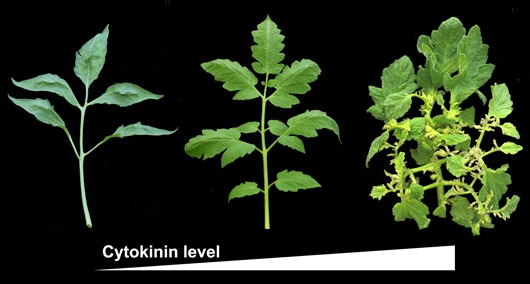
Overexpression of knox genes in various plant species result in a
variety of phenotypes that are similar to those caused by
overproduction of the plant hormone cytokinin.. Expression of kn1 via
the senescence specific promoter SAG12 results in a marked delay in
leaf senescence, accompanied by increased leaf cytokinin content
in older leaves that are expressing kn1. The detached leaf assay, as
well as Arabidopsis plants expressing knox-GR, as described above, will
be used to ask how direct is the effect of kn1 on cytokinin
accumulation. Preliminary experiments show cytokinin accumulation 12-24
hours after dexamethasone induction.
Characterization
of meristem maintenance mutants in tomato. A major question
facing any research in a model organism is the relevance of the
findings obtained to other species. An EMS mutagenized tomato
population has been recently generated by Prof. Dani Zamir (Hebrew
University) (http://www.sgn.cornell.edu/mutants_web/) and will be
available for our use. We are characterizing are screening these
populations for meristem maintenance mutants. These mutants are
characterized and compared to similar mutants in Arabidopsis.
|
|