|
| |
 |
|
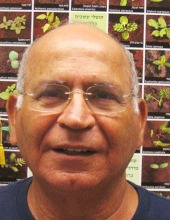
Baruch Rubin
Phone: +972 8 9489248
Fax: +972 8 9362083+972 8 9468265
E-mail: rubin@agri.huji.ac.il
Born: 1943, Tripoli
Degrees: Ph.D. 1976, Hebrew Univ.; Lect. 1978; Sen. Lect. 1983;
Assoc.
Prof. 1989;
Prof. 1995; Jacob and Rachel Liss Professor of Agronomy and
Weed Science 1999
The Weed Science Group
Research Interests
Physiological and biochemical mechanisms of herbicide action in crops
and weeds.
Herbicide resistance in weeds, mechanisms and environmental
implications.
Safe use of herbicide- resistant transgenic crops.
Fate and behavior of herbicides in agro-ecosystem.
Environmentally safe and new herbicide formulations.
Weed biology and ecology.
Weed management and control in major crops.
Research Projects
1. Evolution and mechanisms of herbicide resistance in weeds.
Funding: Chief Scientist's Office, Ministry of Agriculture.
2. Environmental aspects of herbicide resistance in weeds. Funding:
DFG, Germany.
3. Use of sub-irrigation as a method to reduce herbicide use in crops.
Funding: Chief Scientist's Office, Ministry of Environment.
4. Environmentally accepted herbicide formulations. Funding: GIF;
Ministry of Science and Arts, Israel.
5. Weed management with reduced rates of herbicides in regular and
'Roundp-Ready' transgenic cotton. Funding: Chief Scientist's Office,
Ministry of Agriculture.
6. Ecology and Sustainable Control of the Parasitic Weed - Field Dodder
(Cuscuta campestris). USAID, CAR.
Abstracts of Current Research
Herbicide resistance in weeds and in transgenic crops: We are
studying
the mechanisms involved in the evolution and spread of
herbicide-resistant weed populations. So far, we have identified more
than 15 weed species that confer resistance to various herbicide
groups. We elucidated the biochemical and molecular mechanisms involved
in the resistance of grasses and broad-leaf weeds to various
herbicides. We also study the relationships between the resistance
trait, ecological fitness and response to environmental factors. We
developed a rapid method for detection and identification of resistant
plants. We investigate the molecular and biochemical bases for the
herbicide-resistance grasses and parasitic weeds. We also investigate
the impact of using transgenic cotton (''Roundup Ready). on the crop
management and the environment in Israel
Weed ecology and management practices: We directed our research
to the
elucidation of the growth stages in which weeds are most vulnerable to
control measures, and to the understanding of the mechanisms involved
in crop selectivity. We contribute to the improvement of weed
management and reduce herbicide input in Israel's major crops - wheat
and cotton. Using regular and transgenic cotton resistant to the
herbicide glyphosate (''Roundup Ready), we are developing an improved
weed management program, including the control of troublesome weeds
such as purple nutsedge(Cyperus rotundus).
Improved herbicide formulations to reduce contamination of soil
and water: We are trying to reduce the hazard of environmental
damage
due to herbicides by designing clay-based formulations, which will
reduce leaching and migration of herbicides in soil. The herbicides are
sorbed on clays whose surfaces were modified from hydrophilic to
hydrophobic by adsorption of suitable organic cations. Such modified
surfaces better bind hydrophobic herbicide molecules, thus reducing
their concentrations in soil solution and consequently extend their
biological activity. Different approach is manifested for anionic
herbicides: Slow release is achieved by using organic cations with a
large hydrophobic part and very small critical micelle
concentratio(CMC) , such as octadecyltrimethyl ammonium (ODTMA). The
anionic organic molecules bind well to the positively-charged micelles
which attract electrostatically their negatively-charged head groups
and whose interiors provide a hydrophobic environment for the organic
ligand. Then positively charged mixed micelles adsorb on
negatively-charged clay (montmorillonite), which forms aggregates.
Biology, ecology and control of parasitic weeds: We study the
biology
of parasitic weeds - field dodder (Cuscuta campestris) and
broomrape(Orobanche spp), their interaction with host plants and
response to herbicides. We elucidating the mechanisms involved in
resistance of certain host plants to parasitic weeds at the biochemical
and molecular levels.
Patents:
Rubin, B., Y. El-Nahhal, S. Nir, and L. Margulies (2001) . Slow release
formulations of pesticides. US Patent 6,261,997 B1
|
|