|
| |
 |
|
Wolf Shmuel Ph.D
Phone: +972 8 9489428
Fax: +972 8 9462385
E-mail: swolf@agri.huji.ac.il
Born: 1954, Haifa, Israel
Degrees: Ph.D. 1988, Hebrew Univ.; Lect. 1990; Sen. Lect. 1995; Assoc.
Prof. 2001.; Professor 2009
Research Interests:
Study of the factors affecting the productivity, yield accumulation and
quality of vegetable and field crops. Determining the factors
controlling carbohydrate translocation and resource allocation between
the various plant organs. Seed development; environmental effect on the
viability of seeds; the mechanisms involved in the process of seed
germination, with an emphasis on the effect of stressful conditions.
Development of technologies for more efficient hybrid seed production.
Key words:
carbon allocation; carbon metabolism; phloem transport; plasmodesmata;
seed germination
RESEARCH FIELDS AND INTERESTS
Physiology of Crop Production - Within this area, our main
research
topic involves transport processes in plants, with an emphasis on
carbohydrate metabolism and resource allocation among the various plant
organs, using several agronomic crops as model plants.
Following our findings that viral
movement proteins (MPs) alter plasmodesmal function, we developed a
unique experimental system with which we studied the role of
plasmodesmal function in the control of carbon transport in plants. We
established that a constitutive expression of viral MPs in transgenic
plants, cause a significant alteration in the process of carbon
metabolism and resource allocation in plants. Based on these findings,
we hypothesized that the control of plasmodesmal function may offer a
powerful means of affecting sucrose transport into sink organs. The use
of viral MPs to alter sugars content in source leaves and resource
allocation to various sink organs is currently being investigated in
various agricultural crops.
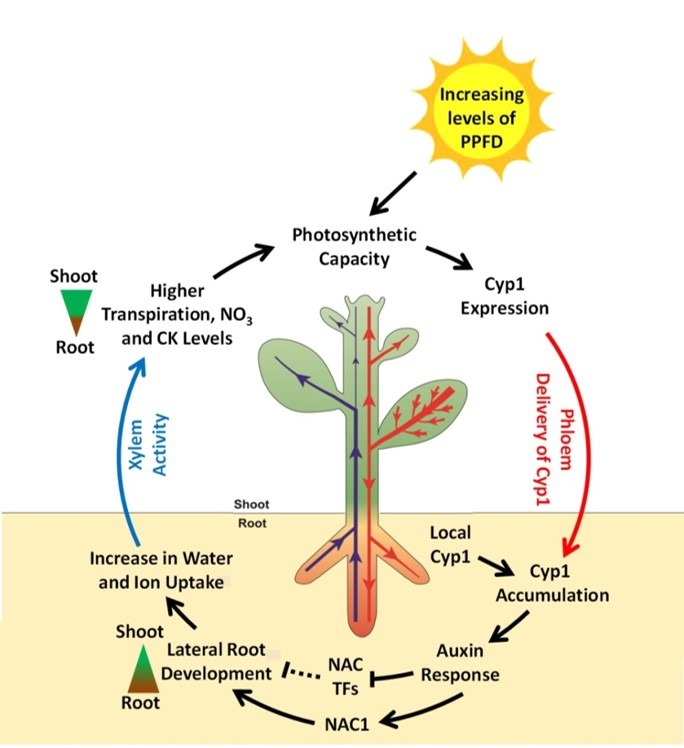
In light of the findings obtained
from our research, we developed the theme that at the whole plant
level, the phloem serves as an information superhighway. Such a
long-distance communication system may utilize a new class of signaling
molecules (proteins and/or RNA) to co-ordinate photosynthesis and
carbon/nitrogen metabolism in source leaves with the complex growth
requirements of the plant under the prevailing environmental
conditions. The discovery that expression of viral MP in plants can
induce precise changes in carbon metabolism and photoassimilate
allocation provided a conceptual foundation for studies (in our
laboratory and around the world) aimed at elucidating the communication
network responsible for integrating photosynthetic productivity with
resource allocation at the whole-plant level. Such information will
surely provide an understanding of how plants coordinate the essential
physiological functions performed by distantly separated organs. Our
present goal is to identify the signal molecules involved in mediating
and controlling the communication between distant plant organs.
Seed production – Within this area, our main research topic
includes
the study of factors controlling seed quality. One of our main studies
has been aimed at exploring the mechanisms enabling low-temperature
germination in tomato seeds, where the endosperm layer has been found
to be the main physical barrier to germination. The activities of
cell-wall-hydrolyzing enzymes are under unique temporal and spatial
control. A current study is aimed at cloning tomato endo-mannannases
and exploring their role in the control of seed germination using a
molecular approach.
Abstracts of Current Research:
Genetic and metabolic networks regulating the nutritional value of
fruits
Plant-based foods are a central element of human survival. In
developing countries, hunger and health problems are directly related
to insufficient amounts of plant foods to supply calories and vitamins.
Plant foods also represent a central nutritional element in developed
countries, and the awareness of their role as health-promoting foods
for improving life expectancy is growing. Examples of the demands in
this category include a number of health compounds such as essential
oils and antioxidants.
The major strategy for enhancing the value of plant foods and feeds
include altering metabolic pathways using genes for enzymes responsible
for the biosynthesis of specific phytochemicals. Detailed knowledge on
metabolite profiles also represent an important factor in determining
the safety of new plant foods.
The proposed research ties together a genomic data with detailed
metabolic profiling in order to explore the genetic regulation of
diverse biochemical pathways and mechanisms determining the development
and the nutritional value of fruits. Israeli and German groups (two
from the Hebrew University, two from The Weizmann Institute of Science
and three from the Max Planck Institutes in Golm), each possessing
complementary expertise in plant genetic and breeding, genomic, fruit
metabolism and biochemistry, have joined together for an in depth study
of fruit metabolism, using top of the art genetic, molecular and
metabolomic approaches. Germplasm representing exotic genetic resources
will be profiled using state-of-the-art microarrays, and
high-throughput metabolic and enzymatic analyses to identify novel
regulatory processes of fruit metabolism. Bioinformatics tools,
incorporating the wealth of EST sequence information and the expected
sequence of the tomato genome, will be used to identify candidate genes
potentially involved in the metabolic variation. Saturated EMS tomato
populations combined with a novel method for rapid identification for
multiple mutant alleles in any sequence (TILLING) will be employed to
characterize the phenotypes associated with altered expression of the
candidate genes. The results of these profiling analyses will generate
novel plant lines for in depth physiological and biochemical research.
The exotic and mutant alleles will be used in classical breeding of
non-GMO varieties with improved health benefits.
REPRESENTATIVE ARTICLES
Lucas, W.J., and S. Wolf (1999). Connections between virus movement,
macromolecule signaling and assimilate allocation. Curr Opin. Plant
Biol. 2: 192-197.
Guenoune, D., R. Amir, B. Ben-Dor, S. Wolf and S. Galili (1999). A
soybean vegetative storage protein accumulates to high levels in
various organs of transgenic tobacco plants. Plant Sci. 145: 93-98.
Wolf, S. and A. Millatiner (1999). Effect of tobacco mosaic virus
movement protein on photosynthesis in transgenic tobacco plants. J.
Plant Physiol. 156: 253-258.
Shalitin, D., K. Shamay and S. Wolf (2000). CMV movement protein
modifies plasmodesmal function in transgenic melon plants. Acta Hortic.
510: 335-341.
Shalitin, D and S. Wolf (2000). Interaction between phloem protein and
viral movement proteins. Aust. J. Plant Physiol. 27: 801-806.
Shalitin, D and S. Wolf (2000).Cucumber mosaic virus infection affects
sugar transport in melon plants. Plant Physiol. 123: 597-604.
Lin, T-B., S. Wolf, A. Schwartz and Y. Saranga (2000). Silverleaf
whitefly stress impairs sugar export from cotton source leaves.
Physiol. Plant. 109: 291-297.
Xu, G., S. Wolf and U. Kafkafi (2001). Interactive effect of nutrient
concentration and container volume on flowering, fruiting and nutrient
uptake of sweet pepper. J. Plant. Nutr., 24:479-501.
Xu, G., S. Wolf and U. Kafkafi (2001). Effect of varying nitrogen
form and concentration during the growing season on sweet pepper
flowering and fruit yield. J. Plant. Nutr. 24: 1099-1116.
Hofius, D., K. Herbers, M. Melzer, A. Omid, E. Tacke, S. Wolf and U
Sonnewald (2001). Evidence for expression level-dependent
modulation of carbohydrate status and viral resistance by the potato
leafroll virus movement protein in transgenic tobacco plants. Plant J.
28:529-543.
Xu, G., S. Wolf and U. Kafkafi (2002). Ammonium on potassium
interaction in sweet pepper. J. Plant. Nutr. 25: 719-734.
Guenoune D., S. Landau, R. Amir, H. Badani, L. Devash, S. Wolf and S.
Galili (2002). Resistance of soyben vegetative storage proteins
(S-VSPs) to proteolysis by rumen microorganisms. J. Agr. Food Chem.,
50: 2256-2260.
Shalitin, D, Y. Wang, A. Omid A. Gal-On and S. Wolf
(2002).Cucumber mosaic virus movement protein affects sugar metabolism
and transport in tobacco and melon plants. Plant Cell Environ. 25:
989-998.
Guenoune D., R. Amir, H. Badani, S. Wolf and S. Galili (2002). Combined
expression of S-VSPa in two different organelles enhances its
accumulation and total lysine production in leaves of transgenic
tobacco plants. J. Exp. Bot. 53: 1867-1870.
Guenoune D., R. Amir, H. Badani, S. Wolf and S. Galili (2003).
Coexpression of the soybean vegetative storage proteins b subunit
(S-VSPb) either with the bacterial feedback-insensitive
dihydrodipicolinate synthase or with S-VSPa stabilizes the S-VSPb
transgene protein and enhances lysine production in transgenic tobacco
plants. Transgenic Res: 123-126.
Complainville A., L. Brocard, I. Roberts, E. Dax, N. Sever, N. Sauer,
A. Kondorosi, S. Wolf and M. Crespi (2003). Nodule initiation involves
the creation of a new symplasmic field in specific roots cells of
Medicago species. Plant Cell 15: 2778-2791.
Nadler-Hassar T., A. Goldshmidt, B. Rubin and S. Wolf
(2004). Glyphosate inhibits the translocation of green fluorescent
protein and sucrose from a transgenic tobacco host to Cuscuta
campestris Yunk. Planta, in press.
|
|